
INTRODUCTION
Sales organizations are experiencing one of the most significant demographic shifts in decades, as Millennial and Generation Z employees increasingly enter sales management roles. This transition is occurring at a time when sales teams are more generationally diverse than ever before, with Baby Boomers, Generation X, Millennials, and Gen Z often working side-by-side in the same salesforce. Although multigenerational sales teams are now a structural reality, research has yet to fully examine how the youngest cohort of sales leaders navigate the complexities of leading older and more experienced team members. This absence of research is notable given that leadership style, communication alignment, and salesforce cohesion are well-established drivers of sales performance, employee engagement, and retention. Prior research in sales has emphasized the importance of leadership behaviors, technology adoption, and employee development for shaping salesperson and team effectiveness (Ahearne et al., 2005, 2007; Hunter & Perreault, 2006), yet little is known about how these dynamics manifest across generational lines, particularly when younger managers supervise older salespeople.
Millennials and Generation Z bring distinct work values shaped by digital nativity, economic uncertainty, flexibility, autonomy, and purpose-driven work (Gabrielova & Buchko, 2021; Stewart et al., 2017; Twenge & Campbell, 2008). These generational characteristics influence how younger leaders communicate, coach, and motivate their teams. For example, younger managers often embrace collaborative decision-making, rapid feedback cycles, and digital communication tools, whereas Baby Boomer and Generation X employees frequently rely on structured communication, hierarchical clarity, and well-established sales routines (Boles et al., 2012; Rodriguez et al., 2012). Prior research suggests that generational cohorts often differ in workplace values, career expectations, and communication norms, creating potential misalignment when individuals from different cohorts interact in professional roles (Costanza et al., 2012; Rudolph et al., 2020; Twenge et al., 2010). For example, Millennials and Generation Z employees tend to value frequent feedback, collaborative communication, and meaning-centered work, whereas older cohorts such as Generation X and Baby Boomers place greater emphasis on hierarchical communication, stability, and deference to experience (Cennamo & Gardner, 2008; Ng et al., 2010). These differences can impact expectations regarding authority, feedback, and leadership communication within multigenerational teams. Research on multigenerational workplaces highlights how conflicting assumptions about work styles, professionalism, and communication can exacerbate misunderstanding and reduce cohesion (Kim, 2018; Ng’ang’a, 2023). Therefore, understanding how these generational differences surface within sales teams is essential for managing conflict, supporting knowledge transfer, and strengthening team performance.
Despite these challenges, research on generational dynamics in sales, particularly from the perspective of Millennials and Gen Z in leadership roles, remains limited. Much of the existing generational research focuses on descriptive differences in attitudes or values, rather than on leadership behaviors or cross-generational management. While sales leadership research has explored empowerment, technology use, and coaching, the field has not addressed how these leadership behaviors are enacted when younger leaders supervise older subordinates. As sales organizations face rising turnover among younger employees (Boles et al., 2012), evolving expectations for meaningful work and flexibility (Stewart et al., 2017), and rapid technology adoption pressures (Ahearne et al., 2007), understanding how emerging leaders navigate multigenerational interactions becomes increasingly strategic.
This study responds to these gaps by exploring how Millennial and Generation Z sales leaders perceive and manage multigenerational dynamics within B2B sales organizations. Through in-depth interviews with 32 emerging sales leaders, we uncover how generational differences in communication norms, adaptability to technology, respect for experience, and openness to change shape day-to-day leadership practices and interpersonal dynamics. Younger leaders frequently interact with older colleagues who bring decades of institutional knowledge and deeply ingrained sales habits. Our findings provide insight into how these leaders make sense of and respond to generational differences, thereby influencing team cohesion, motivation, and performance.
To enrich our understanding of these dynamics, our analysis is grounded in two complementary theoretical frameworks. Generational Cohort Theory (Mannheim, 1952; Twenge & Campbell, 2008) provides a lens for understanding how shared historical and technological contexts shape the values and behaviors of different age cohorts. Role and Identity Theory (Ashforth & Schinoff, 2016) describes how younger leaders construct their professional identities and adapt to leadership expectations, particularly when managing older team members who may perceive roles and authority differently. Together, these frameworks offer a multilevel explanation not only of what younger sales leaders observe in multigenerational teams, but also of why these behavioral patterns emerge in the context of sales leadership and cross-generational collaboration.
This research contributes to the sales literature in three important ways. First, it offers one of the earliest empirical examinations of Millennial and Gen Z sales leaders, addressing a timely yet understudied topic as organizations accelerate the development of younger sales managers (Gabrielova & Buchko, 2021). Second, it extends understanding of sales leadership by illustrating how emerging leaders reconcile their cohort-driven values with the established expectations, communication preferences, and work styles of older team members. This contributes to broader discussions of leadership adaptability, salesforce diversity, and the evolving nature of managerial work. Third, it provides actionable insights for sales organizations seeking to strengthen communication, mentoring, technology adoption, and retention within a multigenerational salesforce (Ahearne et al., 2007; Hunter & Perreault, 2006). As sales teams continue to diversify in age, experience, and technological fluency, understanding how younger leaders manage cross-generational dynamics will be essential for building resilient, adaptive, and high-performing sales organizations.
Consistent with an exploratory qualitative design, this study does not test formal hypotheses but instead seeks to address the following research questions:
RQ1: How do Millennial and Generation Z sales leaders interpret and navigate multigenerational dynamics when managing older subordinates?
RQ2: How do generationally framed differences in communication, authority, and technology adaptation influence leadership identity construction?
RQ3: In what ways do younger leaders transform generational differences into mechanisms of collaboration, such as reciprocal development?
These questions guide our interpretive analysis and situate the findings within Generational Cohort Theory and Role and Identity Theory. We acknowledge long-standing critiques of generational research, particularly concerns that generational categories may conflate age, tenure, or career-stage effects. Consistent with recent qualitative and interpretive scholarship, this study does not treat generation as a fixed explanatory variable. Instead, we examine how Millennial and Generation Z sales leaders themselves invoke generational identities as sensemaking frames when navigating leadership relationships with older colleagues. In this way, generational labels function as socially meaningful categories that shape expectations, communication norms, and interpretations of authority, regardless of whether underlying differences are driven by age, experience, or historical context.
LITERATURE REVIEW
This study is grounded in two complementary theoretical lenses: Generational Cohort Theory and Role and Identity Theory. Together, these perspectives provide a multidimensional foundation for interpreting the identity-driven, relational, and contextual factors that shape how Millennial and Generation Z leaders navigate the complexities of managing multigenerational sales teams. Each framework focuses on different aspects of leadership behavior, enabling a holistic understanding of how younger leaders perceive, interpret, and adapt to generational differences within B2B sales organizations. Before going into detail on each framework, it’s important to define each generation.
Prior research suggests that multigenerational teams often experience tensions related to authority, communication norms, and perceptions of competence. For example, older employees may perceive younger leaders as lacking the experiential depth required for complex decision-making, particularly in industries where tenure has historically signaled credibility (Rodriguez et al., 2012). Conversely, younger leaders may view established routines as resistant to innovation or overly hierarchical. Research on generational workplace dynamics further indicates that differences in feedback expectations, technology adoption, and attitudes toward change can intensify these tensions (Cennamo & Gardner, 2008; Costanza et al., 2012; Ng et al., 2010).
Across multigenerational workplaces, tensions and learning opportunities commonly surface in four domains: (1) communication and feedback norms (Gabrielova & Buchko, 2021; Hill, 2002; Lyons & Kuron, 2014), (2) credibility and authority expectations (Daldrop et al., 2025; Rudolph et al., 2020; Weidner et al., 2024), (3) technology adoption and change receptivity (Ahearne et al., 2007; Hunter & Perreault, 2006; Kim, 2018), and (4) mentoring and knowledge transfer mechanisms (Murphy, 2012; Stewart et al., 2017). These domains are amplified in sales teams, where performance depends on rapid coordination, relational trust, and technology-enabled workflows (Ahearne et al., 2005, 2007; Hunter & Perreault, 2006).
Accordingly, we use these domains as sensitizing concepts that informed the interview protocol and provided an initial organizing frame for analysis, while still allowing themes to emerge inductively from the data (Hsieh & Shannon, 2005; Krippendorff, 2018). In sales contexts, where performance pressure, relational capital, and adaptive responsiveness are central, such tensions may be particularly salient. The juxtaposition of formal authority held by younger managers and experiential authority held by older sellers creates a potential asymmetry that challenges traditional leadership assumptions. These dynamics suggest that younger sales leaders may need to engage in legitimacy-building behaviors, recalibrate communication, and negotiate identity when managing older subordinates. However, existing research has not sufficiently examined how these processes unfold from the perspective of emerging leaders themselves.
Characteristics of Millennial and Generation Z Cohorts
Millennials (Generation Y)
Millennials, typically born between 1981 and 1996, were shaped by the expansion of the Internet, the emergence of social media, and economic turbulence surrounding the 2008 financial crisis. Research consistently shows that Millennials value collaboration, flexibility, inclusivity, and meaningful work (Stewart et al., 2017; Twenge & Campbell, 2008). They tend to prefer participatory communication, work-life balance, and continuous feedback. Their comfort with technology and digital interaction has made them adaptable to rapid technological change, positioning them well for leadership roles in organizations undergoing digital transformation.
Generation Z
Generation Z, born after 1997, represents the first cohort of true digital natives. Growing up in a fully digital ecosystem shaped by smartphones, social networks, streaming media, and algorithmic personalization, Gen Z demonstrates even higher levels of technological fluency, efficiency orientation, and comfort with virtual communication. Research portrays Gen Z as pragmatic, cautious yet innovative, and highly independent (Gabrielova & Buchko, 2021). They value authenticity, transparency, and directness in interpersonal interactions. As employees, they seek purpose in their work, expect rapid advancement, and desire psychological safety in their organizational relationships.
Cohort Comparisons and Implications
Although Millennials and Gen Z share many digital-era traits, important distinctions exist. Gen Z tends to be more individualistic, more entrepreneurial, and more accustomed to rapid information processing than Millennials (Reisenwitz, 2021). Millennials, on the other hand, are often described as collaborative and optimistic, with a stronger focus on team cohesion and organizational belonging. These differences matter for sales leadership because they shape how younger leaders establish authority, build relationships, communicate expectations, and coach team members from older generations.
Generational Differences in Workplace Behavior
Substantial research documents generational differences in workplace values, expectations, and behaviors. Baby Boomers are often associated with loyalty, consistency, and preference for hierarchical leadership; Generation X with autonomy and skepticism; Millennials with collaboration and feedback; and Gen Z with digital fluency and results orientation (Hill, 2002; Mujtaba & Thomas, 2005; Petroulas et al., 2010). These differences influence how employees perceive leadership legitimacy, communication tone, and organizational change.
In multigenerational workplaces, conflicting assumptions about work ethic, communication norms, and technology adoption can lead to misunderstandings or interpersonal tension (Ng’ang’a, 2023). This is particularly relevant in sales, where effective performance relies heavily on clear communication, strong relationships, trust, and adaptability. While prior research highlights these generational contrasts, far less is known about how such differences manifest when younger leaders manage older employees.
Despite its widespread use in management and marketing research, Generational Cohort Theory has been subject to sustained critique. Scholars have questioned whether observed differences attributed to generational cohorts are more accurately explained by age, career stage, tenure, or period effects, highlighting the methodological challenges associated with disentangling these influences. In particular, the age–period–cohort problem (Costanza & Finkelstein, 2015; Lyons & Kuron, 2014; Parry & Urwin, 2011) complicates claims that generational membership independently drives workplace attitudes or behaviors. Critics further argue that generational boundaries are socially constructed and that overreliance on cohort labels risks stereotyping or overgeneralization (Costanza & Finkelstein, 2015). Cohort-defining events such as economic volatility, rapid technological advancement, and shifting sociopolitical conditions influence the expectations that each generation brings into the workplace. Millennials and Generation Z, shaped by digital ubiquity, the Great Recession, and accelerating cultural change, tend to prioritize flexibility, inclusivity, autonomy, and purpose-driven work (Stewart et al., 2017; Twenge & Campbell, 2008). In leadership roles, these values often translate into participatory decision-making, flattened hierarchies, collaborative communication styles, and a strong emphasis on authenticity and empowerment. Understanding these cohort-specific orientations is critical for interpreting how younger sales leaders approach communication, coaching, and team management, particularly when interacting with older employees whose values were shaped by different economic and technological conditions.
Role and Identity Theory provide the primary explanatory mechanism for this study, as it captures how younger leaders construct, negotiate, and legitimize their leadership identities in contexts where age-based expectations may challenge formal authority (Ashforth & Schinoff, 2016). For younger sales leaders, identity work often involves balancing an entrepreneurial, innovation-oriented self-concept with the demands of formal leadership roles that may emphasize stability, authority, and adherence to established processes. This can create tension between self-driven aspirations for autonomy and creativity and organizational norms rooted in seniority, experience, and consistency (Dutton et al., 2010; Ibarra, 1999). When organizational cultures affirm and support these emerging leadership identities by valuing adaptability, technology fluency, and collaborative decision-making, Millennial and Gen Z leaders may be more likely to internalize their leadership roles and demonstrate long-term commitment. Conversely, when their identities conflict with entrenched expectations or resistance from older team members, younger leaders may experience identity dissonance, limiting their effectiveness. Role and Identity Theory, therefore, provides insight into how younger leaders interpret their place within multigenerational teams and how they adapt their behaviors to meet situational demands.
Taken together, these theoretical frameworks provide a comprehensive, multilevel foundation for analyzing the leadership behaviors of Millennial and Generation Z sales managers. Generational Cohort Theory explains the origins of value differences, and Role and Identity Theory reveals how younger leaders negotiate their professional identities within diverse teams. Collectively, these perspectives enable a deeper understanding of how emerging sales leaders conceptualize, enact, and adapt their leadership strategies in the context of multigenerational sales organizations. Grounding this study in these theoretical traditions offers a robust lens for interpreting the qualitative findings and contributes to advancing the discourse on sales leadership, workforce diversity, and generational dynamics.
Sales Leadership and Generational Dynamics
Sales leadership research emphasizes the importance of communication, coaching, empowerment, and technology adoption in driving salesforce performance (Ahearne et al., 2005; Hunter & Perreault, 2006). However, these dynamics may vary significantly across generational lines. Younger leaders often bring strong digital skills and a preference for rapid, informal communication, whereas older employees may rely on experience-based authority and established selling routines. These tensions create challenges for aligning communication rhythms, motivating performance, and encouraging adoption of new tools or processes.
Although studies have examined generational differences in consumer contexts (Reisenwitz, 2021), far fewer have examined generational dynamics within sales teams, especially when leadership responsibilities shift from younger to older cohorts. Early evidence suggests that younger leaders may encounter resistance when introducing new technologies or altering established workflows. In comparison, older employees may perceive younger leaders as lacking the experience required for complex sales situations (Rodriguez et al., 2012). When leadership authority flows from younger managers to older subordinates, it can be interpreted through implicit age-based expectations about who “should” lead. Research on team age prototypes suggests that teams with younger leaders and older followers may be evaluated more harshly because they violate a common “leaders are older” prototype, particularly when performance cues are mixed or negative (Weidner et al., 2024). Related evidence indicates that age bias against young leaders can stem from role incongruity and age stereotypes that reduce perceived leadership suitability, even when effectiveness is not lower (Daldrop et al., 2025). In multigenerational sales teams, these dynamics imply that younger leaders may rely on legitimacy-preserving strategies, such as communication flexing, demonstrating deference to experience, and structuring reciprocal mentoring, while still driving change in technology and process. Conversely, younger leaders often rely on older sellers for institutional knowledge and relationship stability, suggesting opportunities for reciprocal mentoring and collaborative problem-solving.
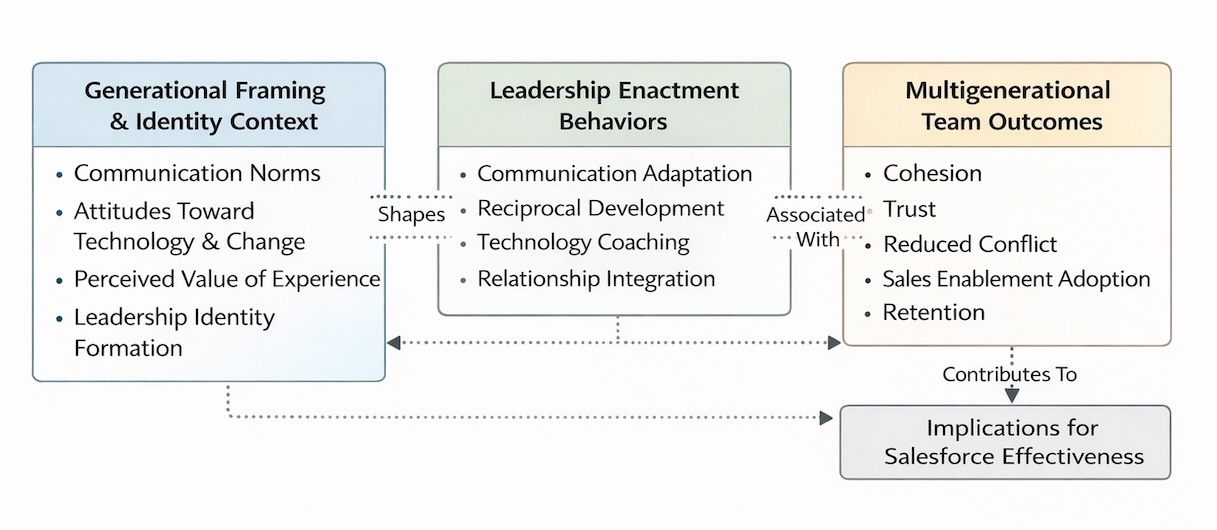
The limited research on generational leadership in sales highlights a significant gap. Existing studies do not sufficiently capture how Millennial and Gen Z leaders interpret and navigate age-based differences, nor how these differences shape communication, trust, conflict, identity work, or team cohesion in B2B environments. Given the increasing presence of younger leaders in sales organizations, and the continued presence of older employees in sales roles, understanding these dynamics is both theoretically and practically essential. Based on the theoretical foundations and prior research, Figure 1 presents a conceptual framework derived from the theoretical perspectives and qualitative findings of this study.
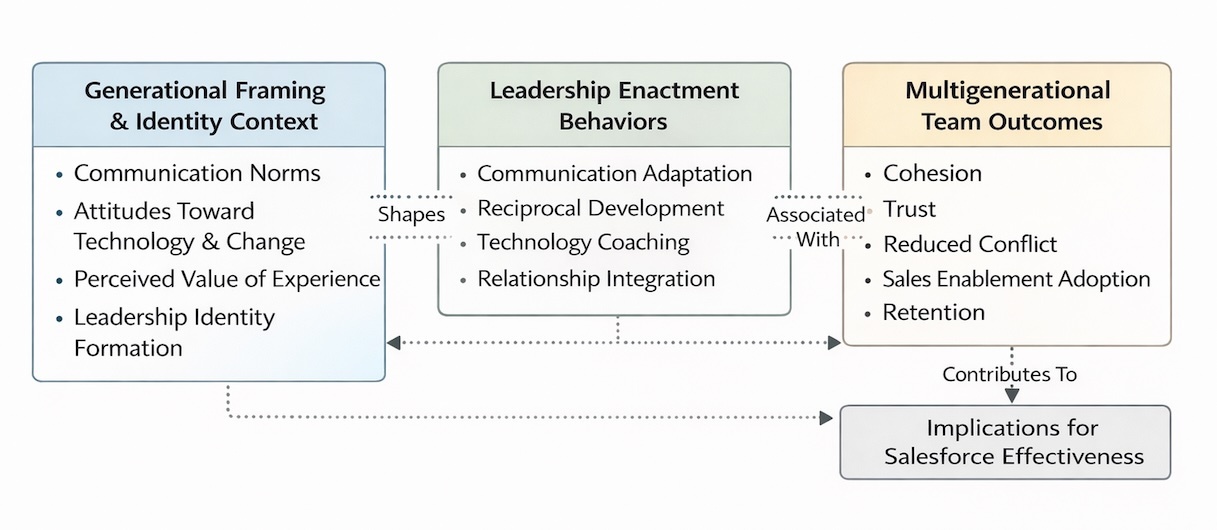
The figure visually organizes how generational identity, communication norms, perceptions of experience, attitudes toward technology, and leadership identity formation interact to shape multigenerational leadership behaviors and team-level outcomes. The directional arrows represent thematic progression and interpretive linkage rather than empirically established causal pathways.
METHODOLOGY
This study employs a qualitative, exploratory research design to investigate how Millennial and Generation Z sales leaders perceive and manage multigenerational dynamics within B2B sales organizations. Given the limited empirical scholarship on younger sales leaders and the complex, socially embedded nature of leadership interactions, a qualitative approach is well-suited for capturing the depth, nuance, and contextual richness of participants’ experiences. Qualitative inquiry allows researchers to uncover emergent patterns that may not be observable through quantitative methods alone (Hsieh & Shannon, 2005; Krippendorff, 2018).
To generate insight into how generational differences shape leadership behavior, we conducted semi-structured interviews that enabled participants to describe their experiences in their own words while providing enough structure to ensure consistency across interviews. This approach aligns with prior exploratory work in sales and organizational behavior, where researchers seek to illuminate underexamined phenomena and theory-building opportunities.
Sampling and Participants
Participants were recruited using purposive sampling to select individuals most capable of providing insight into the research questions. Specifically, we targeted sales leaders who self-identified as members of the Millennial or Generation Z cohorts and who currently held supervisory or managerial responsibility within B2B sales environments. This sampling strategy ensured that participants had both firsthand generational experiences and direct leadership responsibilities that placed them in regular interaction with older team members, including Baby Boomers and Generation X. The sales participants held sustained supervisory responsibilities within a B2B sales organization and managed sales teams as small as 7 and as large as 19. Most participants served as frontline sales managers (e.g., team leads or first-line supervisors), while a smaller subset occupied middle-management roles overseeing multiple teams or regional units. Importantly, all participants supervised at least one older subordinate from a preceding generational cohort (Baby Boomer or Generation X), with most participants managing teams composed of a generational mix rather than same-age peers alone. Participants’ leadership tenure ranged from 2 to 5 years, ensuring that reported experiences reflected sustained multigenerational leadership exposure.
Participants varied in tenure, leadership experience, and organizational context, reducing the likelihood that findings reflect a single career-stage explanation. While all participants identified as Millennial or Generation Z leaders, they differed substantially in years of sales experience, managerial responsibility, and exposure to organizational change initiatives. Similarly, the older colleagues they managed varied in tenure, role seniority, and technological proficiency. This variation allowed for analytic comparison across cases and helped assess whether emergent themes reflected generational identity rather than position- or tenure-based effects alone.
A total of 32 sales leaders participated in the study. Interviews were conducted until thematic saturation was achieved at the conceptual theme level. Saturation was assessed through iterative coding and constant comparison, with researchers tracking the emergence of new first-order codes across interviews. After approximately 27 interviews, no substantively new categories emerged, and subsequent interviews primarily reinforced existing themes rather than extending the coding framework. The final five interviews served to confirm thematic stability across participants. Participants represented a range of industries, including technology, professional services, healthcare, and manufacturing, allowing us to observe consistent cross-industry patterns. Saturation was therefore assessed at the level of core themes rather than industry-specific variation.
Data Collection
Semi-structured interviews were conducted using a standardized interview guide to balance consistency with flexibility. The guide included open-ended questions designed to elicit participants’ perceptions of generational interactions, communication preferences, leadership strategies, and experiences working with older sales professionals. Interview questions were intentionally framed to explore leadership experiences and interpersonal dynamics without presuming age- or generation-based explanations, allowing participants to articulate their own interpretations of difference, authority, and collaboration. The full interview protocol is provided in Appendix A. Key questions included:
-
“How would you describe your experience working with sales team members from other generations?”
-
“Can you recall a time when a generational difference influenced collaboration—positively or negatively?”
-
“What strengths do you see in colleagues from older generations, and what challenges have you encountered?”
-
“What suggestions would you offer to leaders seeking to improve multigenerational teamwork?”
Interviews were conducted via videoconference or phone, recorded with participant consent, and transcribed verbatim to preserve accuracy. Each interview ranged from 30 to 60 minutes in duration. Table 1 provides a visual summary of the themes and subthemes to help readers see the findings at a glance.
Data Analysis
Data were analyzed using conventional content analysis, which is appropriate for studies seeking to allow themes to emerge inductively from participant narratives (Hsieh & Shannon, 2005). Following established qualitative procedures, the analysis proceeded in several stages. First, each researcher independently conducted open coding of the transcripts to identify key statements, concepts, and impressions. These initial codes were then iteratively grouped into broader categories representing recurring ideas or relationships. To assess intercoder reliability, two researchers independently coded five transcripts (approximately 30% of the dataset) before reconciliation. Initial coding yielded an overall percent agreement of 82% and a Cohen’s Kappa of .70, indicating substantial agreement. Disagreements primarily involved distinctions between closely related interpretive categories (e.g., communication preference versus authority sensitivity, or technology resistance versus change fatigue). These discrepancies were resolved through iterative discussions, comparison of transcript excerpts, and refinement of code definitions, before applying the finalized coding framework to the remaining transcripts. Through collaborative discussion and refinement, the research team developed a set of higher-order themes that captured the underlying patterns in how younger leaders described their experiences managing older sales professionals.
NVivo qualitative analysis software was used to organize data, facilitate coding consistency, and support the development of thematic structures. Intercoder agreement was strengthened through iterative comparison and consensus-building to ensure clarity and reliability in coding decisions. Several strategies were employed to enhance the trustworthiness of the findings. First, triangulation across multiple researchers reduced individual bias in interpreting the data. Second, audit trails documenting coding decisions and theme development provided transparency in the analytic process. Third, verbatim transcription ensured fidelity to the participants’ voices as expressed.
ANALYSIS AND RESULTS
Analysis of the interview data revealed four central themes characterizing how Millennial and Generation Z sales leaders perceive and manage multigenerational interactions within their teams: (1) generationally distinct communication norms, (2) the value and tension surrounding experience-based authority, (3) differing levels of adaptability to technology and change, and (4) the role of mutual respect and mentoring. Together, these themes illustrate how younger leaders navigate the practical and relational challenges of supervising older sales professionals and how generational identities shape leadership behavior in B2B sales settings. Appendix B details the Analytic Procedure and Coding Development.
Theme 1: Generationally Distinct Communication Norms
A dominant theme across interviews was the perceived difference in communication preferences between younger and older generations. Millennial and Gen Z leaders noted that Baby Boomers and many Gen X team members prefer formal, structured communication, often through scheduled meetings, phone calls, or longer emails. In contrast, younger leaders favor brief, continuous, technology-enabled communication such as direct messaging platforms or rapid feedback loops.
Several participants described how these mismatched expectations could create misunderstandings. Older employees sometimes interpreted digital brevity as lack of respect or insufficient detail, while younger leaders perceived lengthy or formal communication as unnecessarily slow. Leaders noted that these differences required deliberate management, with one participant remarking that “the way you communicate is half the battle, Boomers want time and clarity, Gen X wants directness, and my generation wants efficiency.” This theme highlights how communication preferences, shaped by cohort-based experiences, can either strengthen alignment or introduce friction within multigenerational sales teams.
Subtheme 1A: Directness vs. Diplomacy
Younger leaders described themselves as more comfortable with candid, immediate feedback. However, they noted that older colleagues sometimes interpreted direct feedback as overly blunt, prompting leaders to adjust their tone to maintain trust.
Subtheme 1B: Speed of Communication
Participants emphasized that younger leaders’ need for rapid communication sometimes clashed with older employees’ preference for reflection and thoroughness, influencing performance rhythms and expectations.
What is novel in this context is that communication adaptation functioned less as a general leadership skill and more as a legitimacy-preserving strategy, as younger leaders adjusted tone and medium to avoid perceptions of disrespect or inexperience.
Theme 2: The Value—and Tension—of Experience-Based Authority
Younger leaders consistently expressed deep respect for the institutional knowledge and customer relationships held by Baby Boomer and Gen X sales professionals. Participants frequently described older colleagues as “steady,” “polished,” and “strategic,” emphasizing the critical role that experience plays in complex B2B selling environments.
At the same time, this respect was paired with tension. Younger leaders noted that some older employees relied heavily on legacy strategies and resisted new approaches. One interviewee explained, "They’ve been doing it for so long that they feel they already know what works, and that can make change hard." This theme reflects a nuanced leadership challenge: valuing the expertise of older sellers while simultaneously pushing the team toward evolving market realities.
Subtheme 2A: Credibility and Confidence Dynamics
Some younger leaders described feeling pressure to “prove themselves” due to age-related perceptions of inexperience. This required deliberate demonstrations of competence, preparation, and empathy in their leadership roles.
Subtheme 2B: Resistance to Change
Younger leaders encountered varying degrees of resistance when encouraging experienced sellers to adopt new tools, processes, or sales methodologies. While the resistance was rarely personal, it was often tied to comfort with long-standing routines. Rather than viewing experience-based authority as a simple generational difference, younger leaders described it as a persistent leadership constraint that required continuous justification of their role legitimacy—an identity challenge rarely examined in sales leadership research.
Theme 3: Differing Levels of Adaptability to Technology and Change
Another prominent theme concerned generational differences in technology adoption and adaptability to change. Millennials and Gen Z, who grew up with digital technologies, viewed CRM systems, automation tools, analytics dashboards, and AI-supported platforms as natural components of their workflow. Many older team members, however, perceived these tools as disruptive or overly complex.
Participants shared examples of coaching older sellers through CRM updates, digital sales enablement tools, or AI-driven lead scoring systems. Although some older colleagues adapted readily, others expressed frustration or skepticism. One participant reflected, “Many Gen X reps are willing, but Boomers really struggle with the pace of tech change. They want to sell, not update systems.” These differences shaped how younger leaders allocated training time, structured expectations, and communicated the value of new technologies.
Subtheme 3A: Technology as a Generational Bridge or Barrier
In some cases, younger leaders used technology as a bridge, introducing tools that saved time or improved insights. In other cases, technology widened generational gaps, leading to tension or disengagement.
Subtheme 3B: Change Fatigue
Older colleagues expressed feeling overwhelmed by frequent organizational changes, while younger leaders saw adaptability as a core professional requirement. From the perspective of younger leaders, technology adoption was not merely an operational challenge but a symbolic leadership act, where pushing digital tools risked being interpreted as overreach or naïveté, thereby shaping how authority was exercised.
Theme 4: Mutual Respect and Mentoring as Foundations for Collaboration
Despite noted challenges, the interviews consistently revealed strong appreciation across generations and clear opportunities for mutual learning. Younger leaders emphasized the importance of demonstrating respect for older colleagues’ contributions, noting that trust often strengthened when they acknowledged experience and invited input.
Many leaders described intentionally pairing traditional mentoring (older to younger) with reverse mentoring (younger to older), particularly around technology, communication strategies, and digital selling. One Millennial leader explained, “When older reps teach me the industry and I teach them the tech, that’s when we both win.” Importantly, reciprocal development extended beyond informal collaboration and appeared to function as a stabilizing mechanism within multigenerational teams. Younger leaders described relying on experienced sellers for strategic insight and relationship depth, while simultaneously serving as technology guides and process translators. This bidirectional exchange reduced authority tension and reframed generational differences as complementary strengths rather than hierarchical divides. Mentoring emerged not simply as a developmental practice, but as a bidirectional legitimacy mechanism, allowing younger leaders to assert expertise without directly challenging the experiential authority of older subordinates.
Subtheme 4A: Leading with Empathy and Curiosity
Younger leaders found that taking time to understand older colleagues’ perspectives, especially around workload, change, and communication, built credibility and reduced generational friction.
Subtheme 4B: Creating Psychological Safety
Participants highlighted the importance of creating space where all generations felt comfortable sharing concerns, asking questions, and contributing ideas without fear of judgment. Although the themes identified in this study reflect well-documented generational dynamics, their contribution lies in how these dynamics are experienced and enacted by younger leaders supervising older sales professionals. From this vantage point, familiar differences in communication, experience, technology use, and mentoring are not merely interpersonal preferences, but mechanisms through which younger leaders negotiate authority, legitimacy, and leadership identity in multigenerational sales teams.
Across the four themes, the findings reveal that generational differences in communication, experience, adaptability, and relational expectations meaningfully shape the leadership strategies of Millennial and Gen Z sales managers. Younger leaders navigate these differences by adjusting their communication styles, balancing innovation with respect for tradition, and cultivating reciprocal mentoring relationships that leverage each generation’s strengths. Together, these patterns illustrate a complex but promising landscape in which generational diversity—when managed intentionally—can enhance collaboration, learning, and overall salesforce effectiveness.
DISCUSSION
The purpose of this study was to explore how Millennial and Generation Z sales leaders perceive and manage multigenerational dynamics within B2B sales organizations. Role and Identity Theory offers the primary explanatory lens for understanding the findings, while Generational Cohort Theory contextualizes the value orientations and expectations leaders bring into these identity negotiations. Building on these theories, our findings reveal several ways in which intergenerational differences influence communication, collaboration, and leadership effectiveness. While prior research has extensively documented generational differences in communication, experience, and technology orientation, this study advances the literature by showing how these differences are experienced when leadership authority flows from younger to older employees. From this reversed leadership lens, familiar generational dynamics are reinterpreted as identity and legitimacy challenges rather than preference mismatches. Younger sales leaders do not simply manage generational differences; they actively recalibrate leadership behaviors to preserve authority, minimize resistance, and construct credibility in the presence of more experienced subordinates. The current study extends understanding of leadership in sales by uncovering how emerging leaders navigate the complexities of supervising older, more experienced sales professionals.
A central insight from the findings is that communication norms differ considerably across generational cohorts, shaping the rhythm, tone, and perceived quality of interactions within sales teams. Younger leaders tend to favor rapid, digital, and informal communication, whereas Baby Boomer and Generation X team members often prefer structured, direct, and conversational exchanges. These differences mirror generational distinctions highlighted in Reisenwitz (2021), where each cohort brings unique preferences and expectations shaped by its formative years. When communication expectations are misaligned, leaders must adjust their style to build trust and maintain cohesion, demonstrating the importance of communication flexibility as a leadership competency in multigenerational salesforces.
Another key finding concerns the value and tension associated with experience-based authority. Younger leaders expressed a deep appreciation for the institutional knowledge possessed by older sellers, which aligns with prior marketing management research showing that generational differences often reflect different but complementary strengths (Hill, 2002; Mujtaba & Thomas, 2005). However, our study highlights a unique challenge for emerging leaders: balancing respect for legacy selling approaches with the need to drive innovation in a fast-changing sales environment. This tension illustrates how generational differences in perceptions of expertise and credibility can shape leadership identity construction, a phenomenon less emphasized in consumer-focused generational research but critical for understanding workplace dynamics.
Our findings also underscore generational differences in technology adoption and adaptability to change. Similar to the technological fluency distinctions reported in 's study of Gen Y and Gen Z consumers (Reisenwitz, 2021), younger leaders in our interviews seamlessly integrated CRM systems, automation tools, and digital communication platforms into their leadership routines. In contrast, some older sellers expressed frustration or reluctance toward new technologies, requiring younger leaders to act as both coaches and change agents. This dynamic is especially relevant for sales organizations seeking to implement digital transformation initiatives, as generational readiness may influence the pace and success of new technology adoption.
A final theme highlights the role of mutual respect and mentoring in strengthening collaboration across generational lines. This form of reciprocal development represents a particularly meaningful contribution. Prior research has often framed generational differences as sources of friction or misalignment. However, our findings suggest that younger sales leaders frequently transform these differences into structured bidirectional learning opportunities. Reciprocal mentoring served not only as knowledge exchange but also as a legitimacy-building process, allowing younger leaders to assert technological expertise while honoring experiential authority. In this sense, reciprocal development operates as a relational mechanism that reduces generational tension and enhances collaborative adaptation within evolving sales environments. Participants described how reciprocal learning, where younger leaders share technological expertise and older sellers provide strategic and relational insights, helped bridge generational divides. This aligns with prior research suggesting that generational cohorts are not simply defined by differences but also by opportunities for shared development (Petroulas et al., 2010). The evidence from this study reinforces the importance of designing leadership development and sales management practices that intentionally leverage the strengths of each generation.
Overall, the findings contribute to marketing management scholarship by demonstrating how generational differences shape sales leadership processes in ways that parallel but extend beyond consumer behavior research. Whereas prior work focused on psychographics, preferences, and Internet usage patterns across cohorts (Reisenwitz, 2021), our study positions generational identity as a meaningful construct influencing leadership style, technology adoption, mentoring, and team dynamics within B2B sales organizations. By examining generational effects in a managerial context, this research broadens the application of generational cohort theory and adds nuance to the understanding of workforce diversity in sales settings.
THEORETICAL IMPLICATIONS
This study contributes to marketing and sales management theory in several important ways. First, by integrating Generational Cohort Theory and Role and Identity Theory, the study provides a multi-layered theoretical lens for understanding how generational identities influence leadership behaviors within B2B sales organizations. Whereas prior generational studies (e.g., Reisenwitz, 2021) have focused primarily on consumer attitudes and behavioral differences between Generation Y and Generation Z, this research extends the application of generational cohort theory into the domain of organizational leadership and salesforce management. In doing so, it positions generational identity not only as a predictor of consumer behavior but as a meaningful construct shaping leadership style, communication patterns, and relational dynamics inside sales teams.
Second, this study advances theoretical understanding of sales leadership by illustrating how Millennial and Gen Z leaders reconcile their cohort-driven values, digital fluency, desire for transparency, preference for rapid communication, and collaborative decision-making with the expectations and long-standing work habits of older generational cohorts. The findings reinforce the idea that generational cohorts carry deeply embedded value orientations developed during formative life periods (Mannheim, 1952), consistent with the cohort-defining mechanisms described in the article on Gen Y and Gen Z differences (Reisenwitz, 2021). This theoretical extension demonstrates how cohort-based value systems continue to shape professional behavior as individuals enter leadership roles.
Third, the study adds depth to Role and Identity Theory by illustrating the identity work that younger leaders must perform when managing older employees. Participants described navigating tensions between innovation-oriented self-conceptions and traditional organizational role expectations, tensions that are intensified in multigenerational salesforces. This provides empirical evidence for identity construction processes within leadership roles and extends identity-based scholarship into the sales context, where it has been underexamined.
Finally, this study contributes to sales leadership theory by shifting attention from generational differences as descriptive phenomena to generational dynamics as identity challenges embedded in leadership roles. By foregrounding the perspective of younger sales leaders, the findings reveal how authority is negotiated under age-asymmetric conditions, extending Role and Identity Theory into an underexplored sales context. The contribution, therefore, lies not in identifying new generational tensions but in explaining how familiar tensions shape leadership behavior when experience and formal authority are misaligned.
MANAGERIAL IMPLICATIONS
The findings of this study offer several implications for sales leaders seeking to strengthen multigenerational collaboration and performance within B2B salesforces. First, the study underscores the need for communication adaptability. Baby Boomers and Generation X often prefer structured, synchronous, or face-to-face communication, whereas Millennial and Gen Z leaders favor rapid, digital, and continuous communication. Sales managers must intentionally tailor communication strategies to match generational preferences, mirroring the consumer communication distinctions highlighted in generational research (Reisenwitz, 2021). Organizations should train leaders in communication style-flexing to reduce misunderstandings and build cohesion.
Second, the results emphasize the importance of reciprocal mentoring structures. Younger leaders bring technological fluency, digital selling skills, and agile workflows, while older employees provide industry knowledge, client relationships, and strategic insight. Formal programs that combine traditional mentoring (experienced-to-young) with reverse mentoring (young-to-experienced) can accelerate learning, reduce friction, and promote cultural integration.
Third, sales organizations should prepare younger leaders for the relational and emotional complexity of managing older colleagues. Many Millennial and Gen Z leaders described feeling pressure to “prove themselves” because of age-based assumptions about credibility. Leadership development programs should therefore incorporate modules on authority-building, conflict resolution, and identity negotiation to support their transition into supervisory roles.
Fourth, technology adoption strategies must account for generational readiness. While younger leaders excel in digital transformation efforts, some older team members express reluctance or fatigue regarding new technologies. Organizations should invest in inclusive change-management practices that blend clear expectations with empathetic coaching and resource support to ensure smoother transitions to CRM tools, automation systems, and AI-enabled platforms.
Sales organizations must recognize that generational diversity is a strategic advantage when properly managed. Rather than viewing generational differences as obstacles, managers should design processes, training, and team structures that leverage the complementary strengths of each cohort. When younger leaders learn to integrate experience-based authority with digital speed, and older sellers embrace new tools without losing relational depth, the result is a more resilient, innovative, and high-performing sales organization.
LIMITATIONS AND FUTURE RESEARCH
Several limitations present opportunities for future research. First, the findings are based on in-depth interviews with Millennial and Generation Z sales leaders, which, although rich in insight, limit generalizability. The reliance on self-reported experiences may also introduce perceptual bias, as participants interpreted generational dynamics through their own subjective lenses. Future research should build on these findings by employing mixed-method or quantitative designs to examine how widespread these generational leadership patterns are across industries and organizational sizes. Experimental studies could test the relationships identified here and provide stronger causal evidence.
Second, the study focuses exclusively on the perspectives of younger sales leaders. While this lens provides important theoretical and practical insights, it excludes the viewpoints of Baby Boomer and Generation X sales professionals, who may interpret leadership actions and generational tensions differently. Future research should incorporate the perspectives of multiple generations within the same sales unit to create a more complete picture of multigenerational team dynamics.
Third, the study’s qualitative design does not examine how generational leadership dynamics affect objective sales outcomes. While participants described effects on trust, cohesion, and technology adoption, future research could empirically test whether generational alignment between leaders and followers influences metrics such as quota attainment, retention, or customer satisfaction. Longitudinal studies would be particularly valuable for understanding how generational dynamics evolve as younger leaders gain experience or as older workers adapt to technological and cultural changes.
An additional implication emerging from the findings concerns the possibility of role differentiation within multigenerational sales teams. Some younger leaders described older sales professionals as preferring relationship-focused field selling over administrative or technology-intensive tasks, while younger cohorts were often described as more comfortable with digital tools, analytics, and process management. Although this study does not permit generalizable conclusions about generationally aligned role structures, future research could examine whether aligning sales roles with individual strengths, such as pairing relationship-oriented field sellers with technology-enabled sales support functions, enhances team effectiveness and job satisfaction. Longitudinal or experimental designs may be particularly useful in assessing whether strength-based role differentiation mitigates generational tension or improves sales outcomes in multigenerational contexts.
The rapid emergence of artificial intelligence, remote selling environments, and digital-first customer engagement also presents new complexities for intergenerational leadership. These technological shifts may amplify generational differences or create new opportunities for cross-cohort learning. Future research should therefore investigate how AI-enabled sales tools, hybrid work models, and digital collaboration platforms shape generational interactions and leadership development in modern sales organizations. Comparative studies across traditional and digital-native sales teams could help scholars understand how technology mediates or moderates generational dynamics. In conclusion, while this study provides meaningful insights into how Millennial and Generation Z leaders manage multigenerational sales teams, continued research is needed to expand theoretical understanding and provide evidence-based guidance for managing increasingly diverse and technologically dynamic salesforces.
Finally, although participants frequently framed adaptability and resistance to change in generational terms, alternative explanations may also account for these patterns. Differences in technology adoption or change receptivity may reflect cognitive overload, accumulated responsibilities, perceived ownership in decision processes, or learning curve dynamics rather than generational identity alone. Future research should examine structural and psychological antecedents—such as role complexity, change fatigue, and learning agility—alongside generational framing to better disentangle these overlapping mechanisms.