
Introduction
Understanding how consumers evaluate symbolic and experiential products is a central issue in marketing management. Wine is a useful context because it can provide sensory enjoyment while also communicating taste, knowledge, status, and identity. Wine-business research has therefore treated wine consumption as both experiential and symbolic, with consumer knowledge, involvement, aesthetic appreciation, and perceived benefits shaping how consumers evaluate and use the category (Canziani et al., 2016; Hall, 2016; Hollebeek & Brodie, 2009; Wolf et al., 2016). This applied setting is well suited to examining whether the matching principle between consumer orientation and value type helps explain how different perceived value dimensions relate to wine consumption intention.
Research on self-monitoring provides the theoretical foundation for this question. People differ in how much they monitor and regulate their own behavior to fit social situations, a trait called self-monitoring (Snyder, 1974). Classic work shows that high self-monitors, who are especially attentive to social image, respond more favorably to image-oriented advertising appeals, while low self-monitors, who rely more on personal preferences, respond more strongly to appeals based on product quality (Snyder & DeBono, 1985). Attitude-function theory connects this individual difference to why people evaluate products differently: attitudes can serve different psychological functions, including helping people express their identity, adjust to social expectations, or assess practical benefits (Katz, 1960). When a product, message, or value dimension aligns with the function most important to a given consumer, it tends to be more persuasive and motivating, a pattern known as functional matching (DeBono, 1987; Shavitt, 1990).
Existing perceived-value research generally treats value dimensions as parallel predictors of downstream responses, with less attention to when one dimension becomes more consequential than another. Symbolic-consumption research establishes that consumption can express identity, but says less about the conditions under which identity-expressive value becomes especially relevant relative to hedonic value. This study integrates these two streams with attitude-function and self-monitoring theory, identifying social signaling orientation as a category-specific condition that helps explain why one value dimension becomes more consequential than another for a given consumer.
This study extends that principle beyond advertising experiments. Prior self-monitoring and attitude-function research has relied almost entirely on designs where message content is manipulated and consumer responses are observed. What has received much less attention is whether similar matching principles appear in the value perceptions consumers already hold about a product category: the associations they bring to wine before any particular message reaches them. Examining these pre-existing value associations is practically important because most marketing managers begin with consumer research, not message creation. Understanding which value dimension is most motivationally active for a given segment is a prerequisite for designing messages that match it.
The study focuses on three types of perceived value that are relevant to wine consumption. Hedonic value captures the enjoyment and sensory pleasure a consumer associates with wine. Identity-expressive value captures the degree to which wine consumption helps a consumer express or affirm who they are. Social value captures the interpersonal approval or recognition a consumer expects from being seen consuming wine. A consumer’s social signaling orientation (how they use wine consumption communicatively) is then examined as a moderator that may determine which of these value types most strongly predicts consumption intention.
The applied contribution is threefold. First, the study translates self-monitoring and attitude-function logic from advertising experiments to the value perceptions consumers already hold, which is the starting point for most real-world marketing decisions. Second, it separates three perceived value dimensions (hedonic, identity-expressive, and social) that frequently coexist in symbolic categories but may carry different behavioral weight for different consumers. Third, it provides an exploratory psychographic profile showing that the most engaged consumer segment is defined by motivational orientation rather than demographic characteristics, which has direct implications for how wine marketers segment and position their products. The study draws on a sample of Asian and Hispanic/Latino wine consumers in the United States, groups that represent a growing share of the U.S. wine market (Thach, 2026) and in which signaling and identity motivations may vary meaningfully across individuals. In 2025, Hispanic/Latino consumers comprised 16% of U.S. wine drinkers, up from 15% in 2023, while Asian American consumers comprised 6%, up from 5% (Thach, 2026). Earlier category-specific evidence also shows differences in premium purchasing: at-home premium wine purchases were reported by 44% of Asian American, 36% of Hispanic/Latino, 33% of African American, and 31% of White consumers; the corresponding premium by-the-glass figures were 29%, 25%, 23%, and 17% (Thach & Olsen, 2016).
Literature Review
Self-Monitoring Theory and the Matching of Appeals to Consumer Orientations
People differ in how closely they manage their own image in social situations. Some individuals, called high self-monitors, are highly attuned to social cues and adjust their behavior to fit the expectations of those around them (Snyder, 1974). Others, called low self-monitors, rely more on their own internal preferences and are less concerned with how they appear to others. This individual difference, captured by self-monitoring theory, shapes not just social behavior but consumer behavior as well.
Snyder and DeBono (1985) were among the first to apply this logic to advertising. In a series of experiments, they found that high self-monitors responded more favorably to advertisements emphasizing a product’s image and social appeal, while low self-monitors responded more favorably to advertisements emphasizing product quality and performance. Later work extended this pattern across product categories and attitude functions, showing that consumers are generally more persuaded by messages that align with the psychological function their attitudes serve for them (DeBono, 1987, 2006; Shavitt, 1990; Shavitt et al., 1992).
The underlying explanation comes from attitude-function theory (Katz, 1960). Attitudes do not all serve the same purpose: some help people express their identity, some help them gain social acceptance, and some help them assess practical benefits. When a message or product dimension speaks to the same function that is most important to a given consumer, it tends to be more motivating. This matching principle, in which the alignment between a consumer’s dominant motivation and what a message or product offers determines persuasive power, is the foundation the present study builds on.
Perceived Value and Symbolic Consumption
Perceived value research treats consumer evaluation as multidimensional rather than as a single assessment of utility. Consumption-value and PERVAL frameworks distinguish among functional, emotional, social, and related value dimensions (Sheth et al., 1991; Sweeney & Soutar, 2001). Research distinguishing hedonic from utilitarian attitude dimensions further confirms that these evaluative functions are empirically separable and independently associated with consumer behavior (Batra & Ahtola, 1991). In symbolic and experiential categories, these dimensions may be especially important because consumers evaluate products for both private enjoyment and public meaning.
This study focuses on three perceived value dimensions. Hedonic value refers to perceived sensory, emotional, or enjoyment-related value from wine consumption (Hirschman & Holbrook, 1982; Holbrook & Hirschman, 1982). Identity-expressive value refers to perceived value from using wine consumption to express, affirm, or communicate the self (Grubb & Grathwohl, 1967; Sirgy, 1982). Social value refers to perceived social approval, recognition, or interpersonal meaning associated with wine consumption (Sheth et al., 1991; Sweeney & Soutar, 2001).
Wine consumption is suited to this framework because wine can function as an experiential product and as a symbolic object. Prior symbolic-consumption research shows that possessions and product choices can communicate identity, status, and distinction (Belk, 1988; Berger & Heath, 2007; Berger & Ward, 2010; Levy, 1959). Wine-business research similarly emphasizes that wine consumption is shaped by involvement, knowledge, aesthetic appreciation, and perceived personal, symbolic, and social benefits (Canziani et al., 2016; Hall, 2016; Hollebeek & Brodie, 2009; Wolf et al., 2016). These findings support treating wine not only as a beverage choice but also as a category in which enjoyment, identity, and social meaning can coexist.
This wine-specific literature also strengthens the managerial rationale for the present study. If consumers differ in wine involvement, knowledge, and symbolic orientation, then segmentation based only on demographics may miss meaningful differences in how consumers perceive value. Consistent with this view, wine segmentation research has used involvement, lifestyle, knowledge, and extrinsic cues to identify consumer groups with different patterns of consumption and evaluation (Baglione & Stanton, 2026; Hall, 2016). The present study adds to this applied stream by examining whether social signaling orientation conditions the relative associations of hedonic and identity-expressive perceived value with intention. The next section defines this moderator and explains how it differs from the value constructs already introduced.
Social Signaling Orientation
The key moderator in this study is social signaling orientation, the degree to which a consumer treats wine consumption as a form of social self-presentation. Building on Snyder’s (1974) self-monitoring framework and on research showing that product choices can serve as signals of identity and social distinction (Berger & Heath, 2007; Berger & Ward, 2010; Goldstein & Dubois, 2025), social signaling orientation captures whether a consumer approaches wine primarily for what it communicates to others, including taste, sophistication, and cultural knowledge, or primarily as a source of private enjoyment. Importantly, this construct is measured as a wine-specific motivational orientation rather than a general personality trait (DeBono, 2006), which allows the study to assess whether the signaling motive is active in this product category for a given consumer, independent of their broader self-monitoring disposition.
It is worth clarifying how social signaling orientation differs from two related constructs in the model. Social value is a perceived benefit, specifically the belief that drinking wine will earn social recognition from others (Sheth et al., 1991; Sweeney & Soutar, 2001). Identity-expressive value is another perceived benefit, the belief that wine consumption reflects and affirms who a consumer is (Grubb & Grathwohl, 1967; Sirgy, 1982). Social signaling orientation, by contrast, is a motivational orientation: the tendency to approach wine consumption as a communicative act in the first place (DeBono, 2006; Snyder, 1974). A consumer can hold strong social value perceptions about wine, believing it signals sophistication, for instance, without primarily choosing wine for that reason. The three constructs are related but empirically distinct, and the analysis estimates their unique associations simultaneously to preserve that distinction.
Hypotheses
The foregoing review points to three perceived value dimensions, one moderator, and a predicted crossover pattern. The hypotheses formalize those predictions. Hedonic value captures the enjoyment and sensory pleasure consumers associate with wine. Because experiential enjoyment is a well-documented driver of consumption behavior (Hirschman & Holbrook, 1982; Holbrook & Hirschman, 1982; Jung & Sharma, 2025), it should be positively associated with wine consumption intention. Identity-expressive value captures whether wine helps a consumer express or affirm who they are. Because self-expressive consumption is a recognized behavioral motivator across product categories (Grubb & Grathwohl, 1967; Sirgy, 1982), identity-expressive value should similarly predict intention.
H1: Hedonic value is positively associated with wine consumption intention.
H2: Identity-expressive value is positively associated with wine consumption intention.
Social value is expected to have a weaker association with intention once the other value dimensions are modeled. Social approval describes a consequence of consumption that others assign rather than an internal motivation that drives it. When hedonic enjoyment and identity expression are already accounted for, social value’s residual association may diminish or reverse, because it overlaps with identity expression but captures none of the private enjoyment that independently predicts intention.
H3: Social value will have a weaker association with consumption intention than hedonic value or identity-expressive value when all three are modeled simultaneously.
Social signaling orientation is expected to shift the relative weight of the functions consumers seek from wine. When signaling orientation is low, the evaluative question is primarily experiential: does this feel enjoyable to me? When signaling orientation is high, the question becomes more self-presentational: what does this choice communicate about me? Attitude-function theory therefore implies greater weight on identity-expressive value as signaling orientation increases and, correspondingly, less relative weight on hedonic value. This pattern mirrors the classic finding in advertising research that image-oriented appeals resonate more with image-conscious consumers, now applied to the value structures consumers bring to a category on their own (Snyder & DeBono, 1985).
H4: Social signaling orientation weakens the positive relationship between hedonic value and consumption intention.
H5: Social signaling orientation strengthens the positive relationship between identity-expressive value and consumption intention.
Methods
Sample and Procedure
Participants were recruited via Prolific for an online survey of U.S. wine consumers. Recruitment criteria specified adults ages 21 to 100 residing in the United States who drink wine and belonged to selected Asian and Latino ethnic-background categories; age and ethnicity were reconfirmed within the survey. The final analytic sample was N = 235. Participants ranged in age from 21 to 77 years (M = 39.04, SD = 11.75). This sampling frame was selected because Asian and Hispanic/Latino wine consumers represent a growing and understudied segment of the U.S. wine market, and the symbolic meaning of wine consumption, the dimension most relevant to signaling and identity, is likely to vary meaningfully across individuals. The sample is appropriate for examining how perceived value and social signaling orientation relate to wine consumption intention within these groups, but it should not be treated as representative of all U.S. wine consumers. The survey measured perceived value dimensions, social signaling orientation, consumption intention, consumption frequency, product knowledge, childhood product socialization, demographic variables, and cultural-background variables.
Measures
Hedonic value was measured using four items capturing sensory pleasure, emotional reward, and enjoyment from the PERVAL emotional value scale (Sweeney & Soutar, 2001; α = .893). This operationalization follows Hirschman and Holbrook (1982) in treating emotional reward and experiential enjoyment as the behavioral core of hedonic consumption, and is consistent with prior wine-value research using the PERVAL emotional value subscale to capture hedonic motivations. Identity-expressive value was measured using five items adapted from identity-expression and self-congruity research, assessing whether wine consumption reflects and affirms the consumer’s self-concept (Sirgy, 1982; α = .870).
Social value was measured using six PERVAL items capturing perceived social approval, acceptance, and interpersonal recognition (α = .871). Social signaling orientation was measured with five context-specific items assessing the extent to which the consumer views wine consumption as a tool for self-presentation, social communication, and impression management (α = .927). Consumption intention was measured with three items adapted from Simpson-Rojas et al. (2024), assessing future wine consumption intention (α = .713). Consumption frequency was measured with a single seven-point behavioral frequency item. Quality value was measured with four PERVAL quality items (α = .899) and used in supplemental robustness analyses.
Control variables included age, gender, education, income, subjective product knowledge, wine consumption frequency, and childhood product socialization. Childhood product socialization was included as a control because prior exposure to wine in the household of origin is associated with familiarity, involvement, and evaluative predisposition toward wine, and may independently predict intention and value associations (Wolf et al., 2016). Childhood product socialization was measured with three items assessing household-level exposure to wine while growing up: “Wine was regularly served in my household when I was growing up,” “Adults in my household drank wine,” and “Wine was present at family gatherings and celebrations” (7-point scale, 1 = strongly disagree to 7 = strongly agree; α = .876). To assess discriminant validity among the conceptually adjacent focal constructs, variance inflation factors were examined in the focal regression model. All VIFs were below 3.5, indicating that multicollinearity does not account for the pattern of results. Heterotrait-monotrait (HTMT) ratios for all construct pairs ranged from .17 to .72, all below the .85 discriminant-validity threshold. Table 1 reports the full measurement items, sources, standardized loadings, Cronbach’s alpha, composite reliability, and average variance extracted.
Two items in Table 1 showed comparatively low standardized loadings: the Consumption Intention item “I would choose to consume wine over other alcoholic beverages” (λ = .462) and the Social Value item “As a present, wine would make a good impression on others” (λ = .586). Both were retained. Following the guideline that indicators loading between .40 and .70 should be removed only if doing so increases composite reliability or average variance extracted above the recommended threshold (Hair et al., 2019), this was checked directly: for Consumption Intention, removing the .462 item would leave only two indicators, and composite reliability (CR = .742) and average variance extracted (AVE = .503) already exceeded conventional thresholds with the item retained. The item also captures a distinct facet of intention, choice relative to other alcoholic beverages, that the remaining two items do not. For Social Value, the .586 loading exceeds the .40 floor, and construct-level reliability and validity (CR = .875, AVE = .541) were unaffected by its inclusion; the item reflects a gifting-specific facet of social value distinct from the other five items, which concern personal impression management. Retaining both items therefore does not materially compromise the reliability or validity of either construct.
Analytic Strategy
The analysis proceeded in three steps. First, a simultaneous regression model estimated the unique associations of hedonic value, identity-expressive value, and social value with consumption intention, thereby testing H1, H2, and H3. Second, moderation models tested whether social signaling orientation conditioned the hedonic value–intention and identity-expressive value–intention associations, corresponding to H4 and H5. Third, an exploratory quadrant analysis translated the continuous constructs into descriptive profiles for managerial interpretation. The quadrant analysis is a descriptive visualization based on social signaling orientation and hedonic value; it does not depict the identity-expressive interaction in H5. Both H4 and H5 are tested inferentially in the continuous moderation model in Table 3, and the quadrant analysis is not used as a primary theoretical test.
Results
The six-factor measurement model showed adequate but not strong fit: scaled χ2(309) = 688.83, robust CFI = .901, robust TLI = .887, robust RMSEA = .077 (90% CI [.069, .085]), and SRMR = .067. Composite reliability ranged from .742 to .928, AVE ranged from .503 to .722, and HTMT values ranged from .17 to .72. A one-factor model fit the data substantially worse (robust CFI = .489, RMSEA = .171, SRMR = .141), providing additional evidence that a single common factor does not account for the measurement structure.
Table 2 reports descriptive statistics and zero-order correlations for all study variables. The pattern of correlations supports the multidimensional structure of perceived value and confirms that simultaneous modeling is warranted given the moderate associations among the focal constructs.
Perceived Value and Consumption Intention
The first regression model tested H1, H2, and H3. Consumption intention was regressed on the three perceived value dimensions, social signaling orientation, and controls (Model 1 in Table 3). The model explained substantial variance in consumption intention (R2 = .581, F(11, 223) = 28.06, p < .001). Variance inflation factors for all predictors were below 3.5, suggesting that multicollinearity does not account for the observed pattern of associations. As shown in Table 3, hedonic value (b = .311, SE = .078, p < .001) and identity-expressive value (b = .301, SE = .084, p < .001) were positively associated with consumption intention. These results support H1 and H2 within this sample.
Consistent with H3, social value had a weaker unique association than hedonic value and identity-expressive value in the simultaneous model. In isolation, social value was positively associated with intention (r = .21), but its coefficient became negative after hedonic and identity-expressive value were entered simultaneously (b = -.158, SE = .075, p = .036). Because social value overlaps with hedonic value (r = .40) and identity-expressive value (r = .50), the sign reversal is consistent with a suppression-like shared-variance pattern. The VIF and HTMT results indicate that severe multicollinearity or construct redundancy is unlikely to be the sole explanation, but the reversal should not be interpreted as evidence that perceived social approval generally reduces consumption intention.
Moderation by Social Signaling Orientation
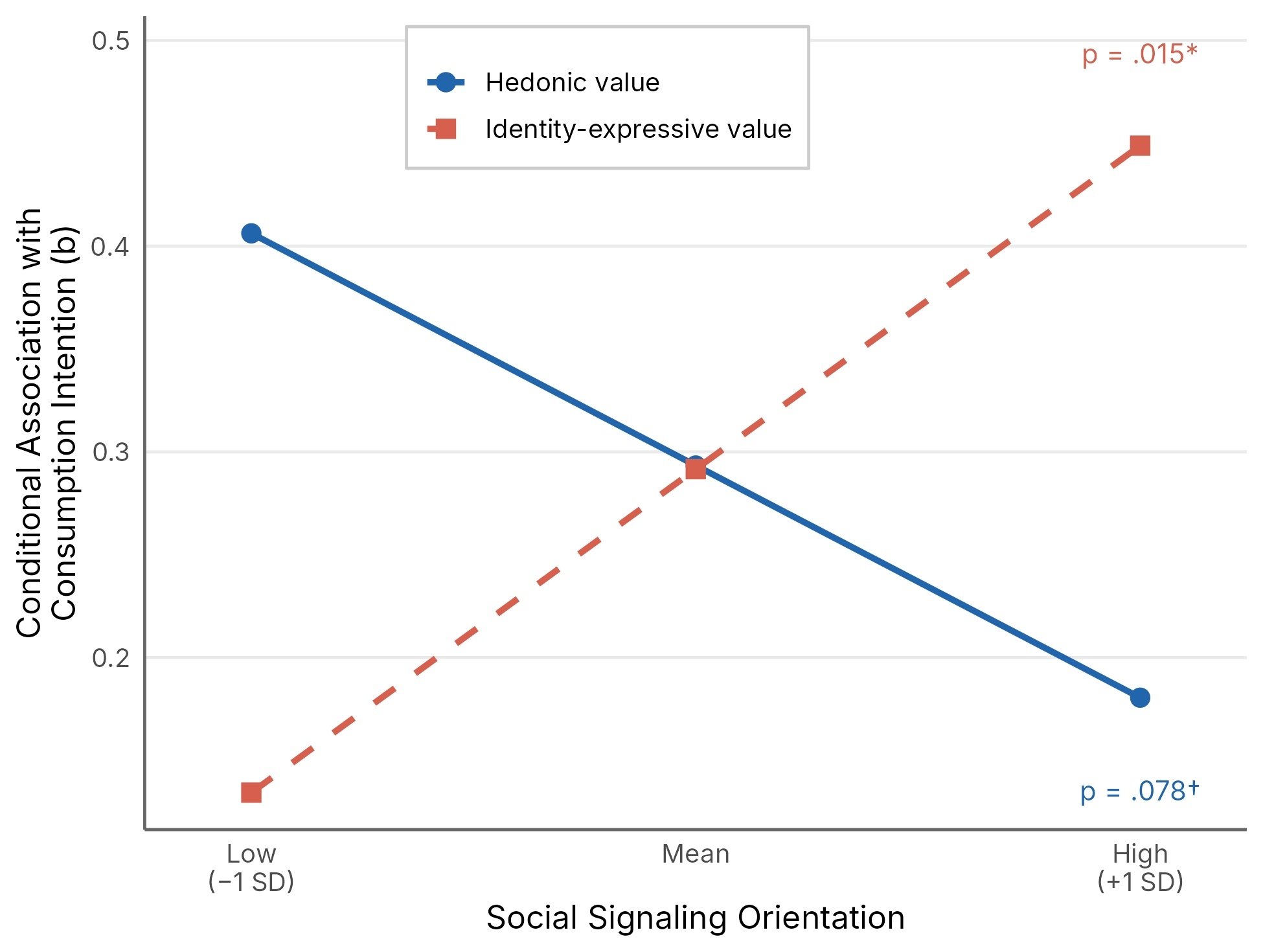
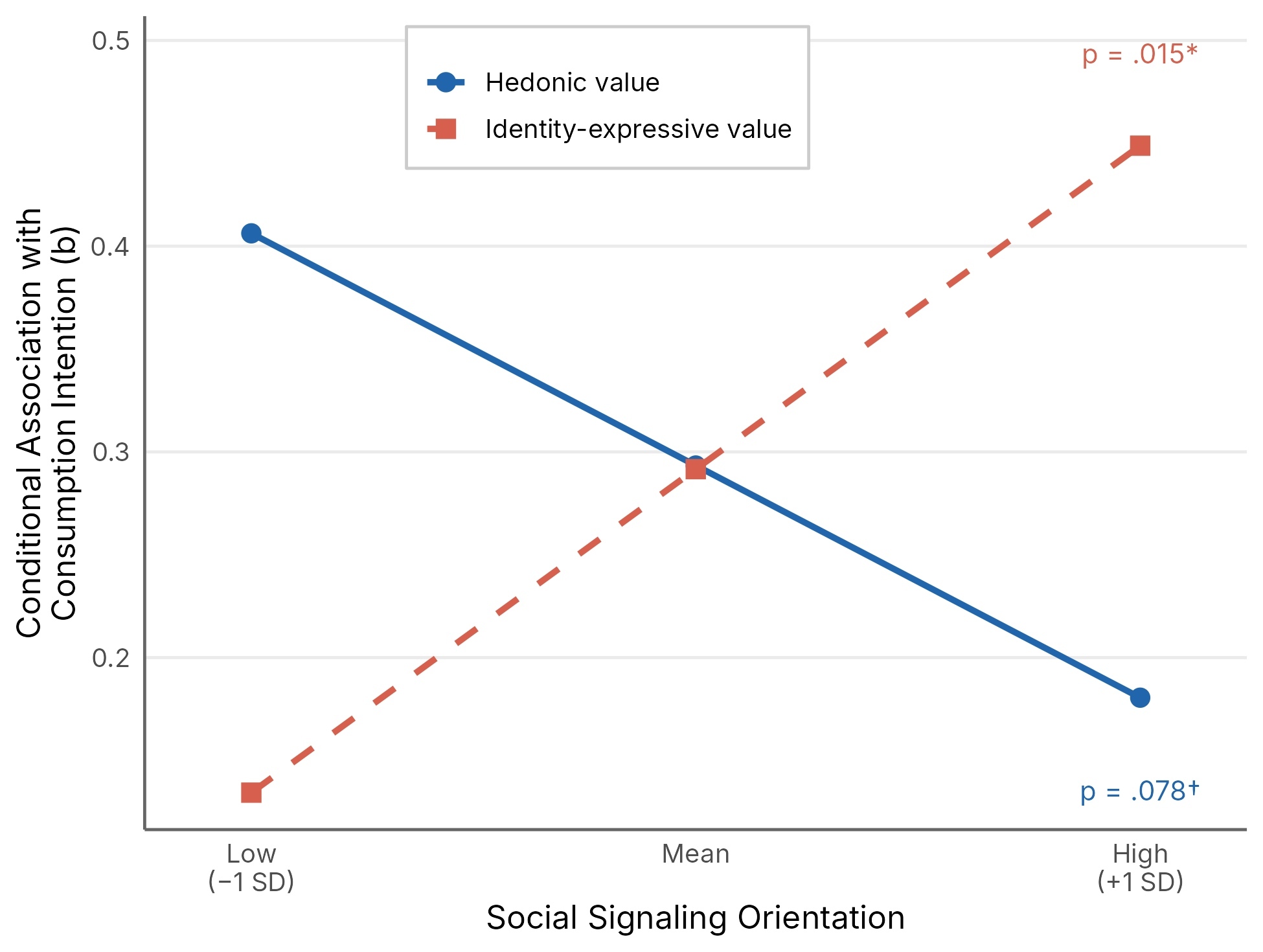
To test H4 and H5, the regression model was expanded to include social signaling orientation and its interaction terms with hedonic value and identity-expressive value. The focal continuous predictors were standardized (z-scores) before creating interaction terms (Model 2 in Table 3). The interaction between identity-expressive value and social signaling orientation was statistically significant (b = .157, SE = .064, p = .015), supporting H5.
The interaction between hedonic value and social signaling orientation was marginal and did not meet conventional significance thresholds (b = -.113, SE = .064, p = .078). Thus, the result is directionally consistent with H4, but the evidence for the hedonic-value moderation pattern should be interpreted cautiously. The stronger evidence concerns the identity-expressive value interaction. Table 4 presents the conditional slopes for all three value dimensions, and Figure 1 plots the conditional associations for hedonic and identity-expressive value. Because the model does not include an interaction between social value and signaling, the social value slope is the same at all three signaling levels (b = -.147).
Exploratory Psychographic Segment Profile
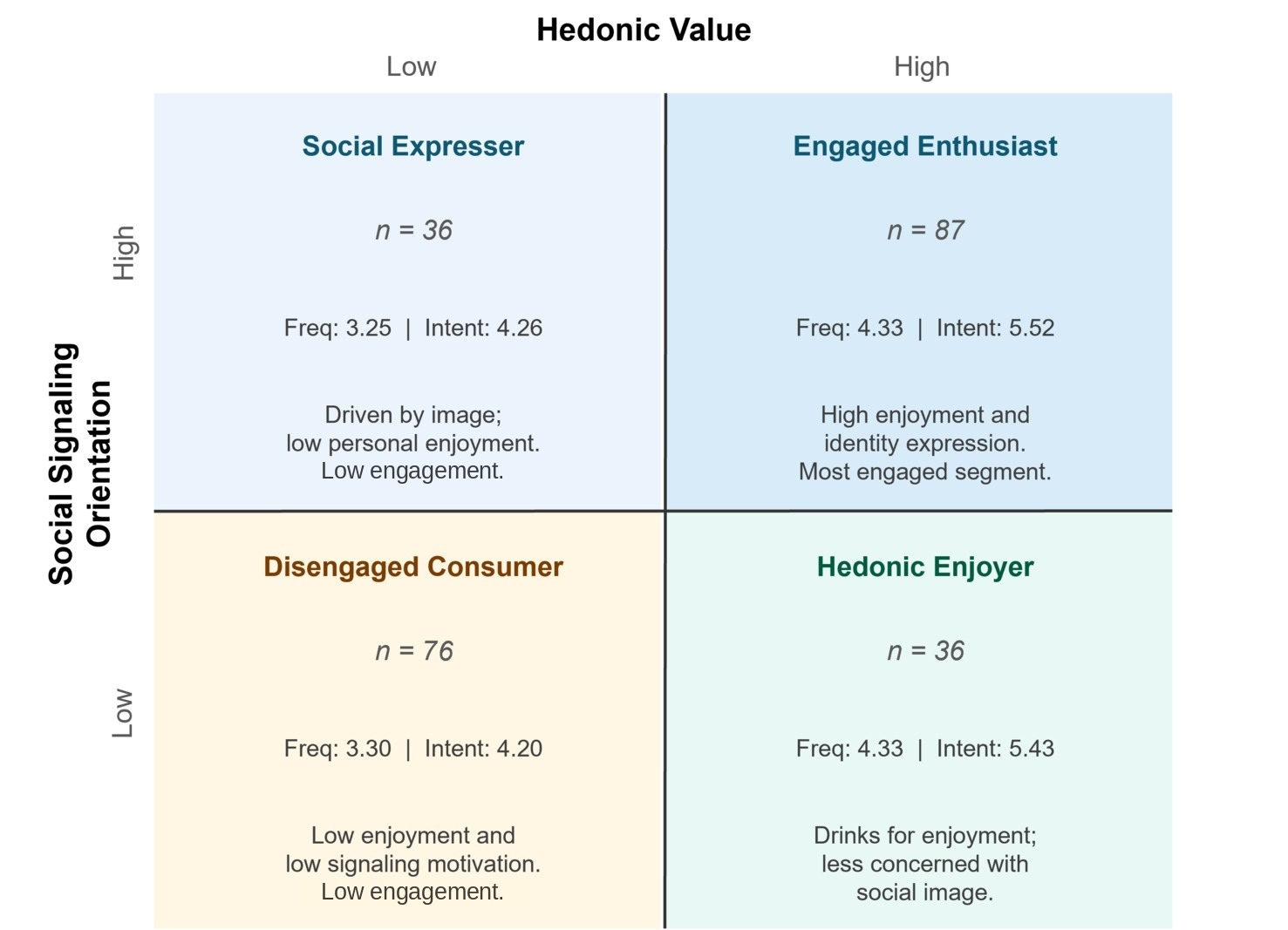
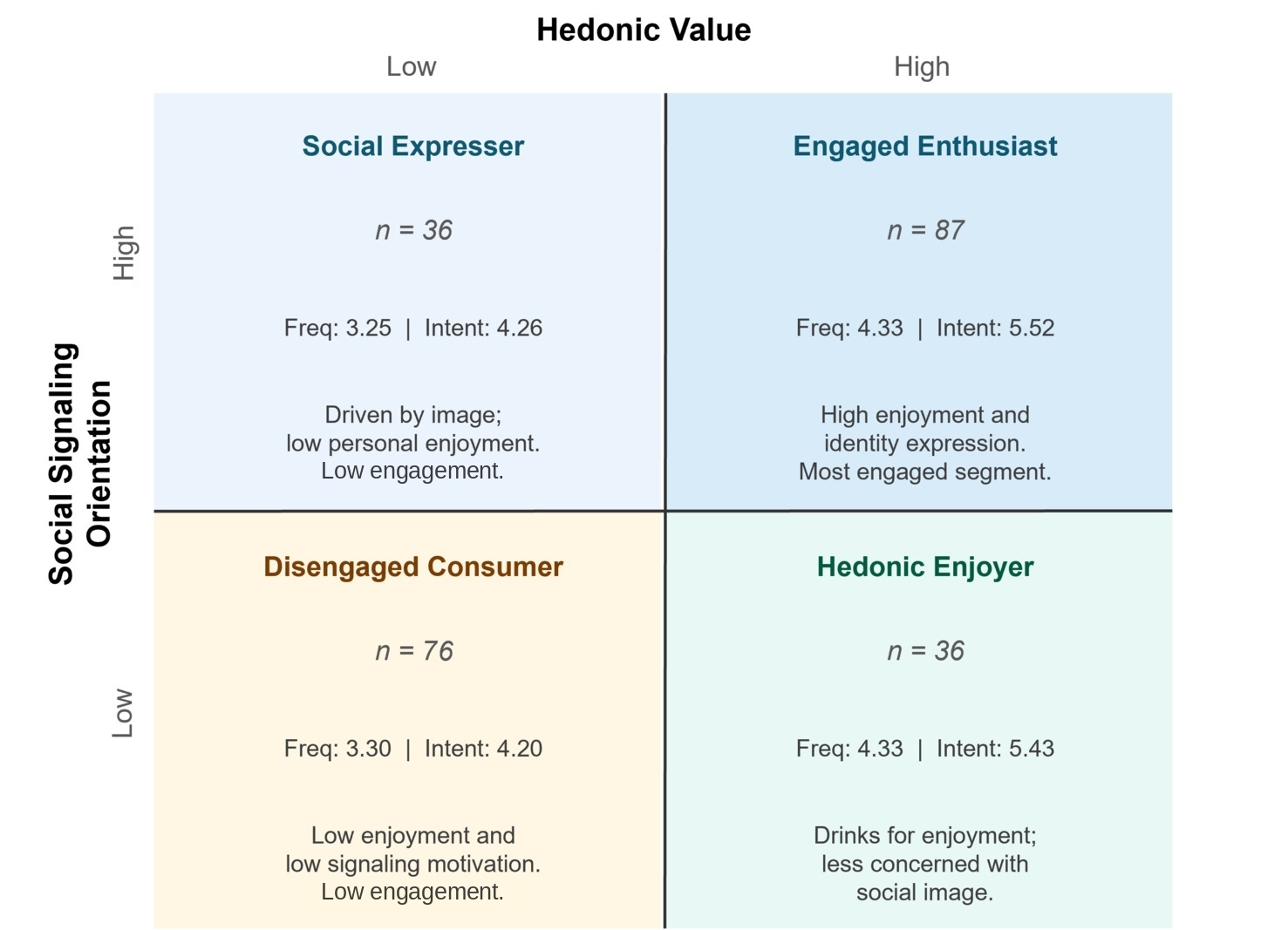
To provide a managerially interpretable profile, an exploratory quadrant analysis was conducted based on median splits of social signaling orientation and hedonic value. This analysis is descriptive and should not be interpreted as a substitute for the continuous moderation model. While median splits reduce continuous variance and are acknowledged as a limitation (MacCallum et al., 2002), they are used here as a practical visualization device rather than an inferential test. The quadrant analysis does not depict the identity-expressive interaction in H5; both H4 and H5 are tested in the continuous moderation model in Table 3. Respondents were grouped into four categories: High Signaling/High Hedonic (n = 87), High Signaling/Low Hedonic (n = 36), Low Signaling/High Hedonic (n = 36), and Low Signaling/Low Hedonic (n = 76).
The segments differed significantly in consumption frequency (F(3, 231) = 19.51, p < .001) and consumption intention (F(3, 231) = 27.01, p < .001). The High Signaling/High Hedonic segment reported elevated engagement, with a consumption frequency mean of 4.33 and an intention mean of 5.52. The Low Signaling/High Hedonic segment reported an equivalent frequency mean (4.33) and a comparable intention mean (5.43), indicating that strong personal enjoyment is associated with engagement even when social signaling orientation is low.
Within this sample, quadrant membership was not significantly associated with broad demographic variables. Income did not differ across groups (F(3, 231) = 1.10, p = .349), and education did not differ significantly, although the effect approached conventional significance (F(3, 231) = 2.55, p = .056). Ethnicity (p = .628) and gender (p = .345) were not significantly associated with quadrant membership. The High Signaling/High Hedonic group was distinguished more clearly by psychological and cultural-meaning variables, including subjective product knowledge, childhood product socialization, and identity-expressive value. An alternative signaling-by-identity-expressive profile was also examined. The hedonic axis produced larger separation in consumption frequency (η2 = .202 versus .110) and intention (η2 = .260 versus .177), so it was retained for the exploratory illustration. This descriptive axis choice does not affect the tests of H4 or H5.
Robustness and Supplemental Analyses
As a supplemental check, perceived quality value was entered as a fourth value dimension in a simultaneous model. Quality value was marginally associated with consumption intention (b = .113, SE = .062, p = .070). Including quality value did not alter the primary pattern: hedonic value and identity-expressive value remained positive unique correlates of intention, and the moderation pattern remained centered on the identity-expressive value interaction.
Discussion
The results indicate an asymmetric pattern consistent with the proposed crossover. Identity-expressive value becomes more strongly associated with wine consumption intention as social signaling orientation increases, whereas the corresponding weakening of the hedonic-value association is directional but only marginally significant. This pattern is consistent with self-monitoring and attitude-function research showing that the persuasive weight of different types of value depends on the motivational function the consumer is pursuing (DeBono, 2006; Snyder & DeBono, 1985). The study extends that principle from experimentally manipulated advertising appeals to the value structures consumers already hold, addressing a diagnostic gap that is practically relevant for marketing managers who need to understand their consumers before designing messages.
The clearest empirical result is the interaction between social signaling orientation and identity-expressive value. When consumers view wine consumption as socially communicative, identity-expressive value has a stronger association with intention. Evidence for hedonic-value moderation is weaker because the interaction is marginal. The results therefore suggest an asymmetric moderation pattern rather than a fully supported hedonic-to-identity crossover.
The social-value result should be interpreted as a unique-association finding within a simultaneous model. Social value is positively associated with intention at the zero-order level, but its coefficient becomes negative only after hedonic and identity-expressive value are entered simultaneously. This reversal is consistent with a suppression-like shared-variance pattern and should not be interpreted as evidence that perceived social approval generally reduces consumption intention. The result instead suggests that marketers and researchers should distinguish perceived social approval from hedonic enjoyment and identity expression when diagnosing consumer value perceptions.
Theoretical Implications
The theoretical implication follows from the distinction drawn above between designed communications and the value structures consumers already hold. If functional matching operates on perceptions consumers bring to a category rather than only on manipulated message content, then self-monitoring and attitude-function theory can be extended beyond their traditional role of guiding persuasive-message design: they can also serve a diagnostic function, identifying which value dimension is currently active for a consumer before any message is created. Social signaling orientation operationalizes this diagnostic use as a category-specific condition, showing that the mechanism responsible for message-appeal effectiveness in prior research also organizes naturally occurring heterogeneity in how consumers already relate to a product category. Future theoretical work in this space should treat attitude functions as both a persuasion lever and a measurable individual-difference variable, rather than as something inferable only from responses to manipulated stimuli.
The exploratory quadrant analysis provides an applied profiling tool. Within this sample, the psychographic profiles differed more clearly on engagement, product knowledge, and identity-related variables than on broad demographic indicators. This pattern is consistent with wine-segmentation research emphasizing the managerial value of involvement, knowledge, and value-based profiles (Baglione & Stanton, 2026; Canziani et al., 2016; Hall, 2016). The quadrant results should therefore be read as a practical illustration of segmentation logic, not as a substitute for the continuous moderation model or as evidence that demographics are generally unimportant. Because the analysis is exploratory and based on median splits, it should inform hypothesis generation for future confirmatory or experimental work rather than stand alone as a basis for segmentation or targeting decisions.
Taken together, the findings suggest that the motivational meaning of perceived value is not fixed: the same value dimension can be behaviorally central for one consumer and peripheral for another, depending on what function wine consumption serves. This has implications beyond wine. In any symbolically rich category where consumers differ in whether they consume for private enjoyment or social communication, value perceptions alone may be insufficient predictors of behavior without accounting for the motivational orientation that activates them.
The focus on Asian and Hispanic/Latino wine consumers should be viewed as a deliberate empirical choice as well as a boundary on generalizability. These groups are large, growing, and historically underexamined in wine-consumer research. Their inclusion broadens the empirical base of wine-marketing research and provides a useful context in which the relative roles of enjoyment, identity expression, and social signaling can be examined.
Beyond market growth, there is a conceptual reason as to why identity-expressive value and social signaling orientation may be particularly variable within this sample. Some consumers in these groups navigate multiple cultural reference points, so the symbolic meaning of wine may be interpreted differently across audiences and situations. This makes the sample relevant for examining variation in identity-expressive and self-presentational motives. I present this as a rationale for the sampling frame, not as a cultural difference tested directly in the present study.
Managerial Implications
Consumer segmentation in symbolically rich product categories has long struggled with a fundamental limitation: demographic variables predict who consumers are but not why they consume. Income, education, and ethnicity consistently fail to explain meaningful variation in engagement within a category once basic access is controlled, a pattern well documented in consumer behavior research and increasingly acknowledged in marketing practice (Baglione & Stanton, 2026; Wedel & Kamakura, 2000). The present findings reinforce this limitation directly: the most engaged segment in this study is demographically indistinguishable from the least engaged, but differs sharply on motivational orientation. This suggests that the diagnostic starting point for segmentation in categories like wine, craft beverages, fashion, and other symbolically loaded goods should be motivational profiling rather than demographic filtering.
The practical implication is that managers in these categories need to identify, before message design begins, whether a given segment is primarily motivated by private enjoyment or by the identity and social communication that consumption enables. These two motivational routes call for fundamentally different creative strategies. Consumers driven by hedonic value respond to messages that center sensory experience, pleasure, occasion, and personal indulgence (Katz, 1960; Shavitt, 1990). Consumers driven by identity-expressive value respond to messages that signal discernment, taste, cultural knowledge, and self-definition (Shavitt, 1990; Snyder & DeBono, 1985). Applying the wrong frame to either group reduces the motivational relevance of the message before it is tested, which means resources spent on message optimization may be wasted if the upstream segmentation question is answered incorrectly.
These findings suggest distinct creative directions that managers can test across signaling profiles. Lower-signaling consumers may respond to appeals centered on sensory experience, relaxation, at-home pairing, and private enjoyment. Higher-signaling consumers may respond to provenance, connoisseurship, limited releases, gifting, and visible social occasions. These are positioning implications suggested by the moderation results and should be validated through campaign testing rather than treated as causal effects established by the present survey.
This distinction has become more consequential as brand communication has shifted toward social and creator-driven media. Identity-expressive consumers are not only more likely to respond to identity-oriented brand messages, but also more likely to share, post, and generate content around the category because consumption in a publicly visible format is itself part of the motivational function they are pursuing (Berger & Heath, 2007; Berger & Ward, 2010). Brands that correctly identify and reach the identity-expressive segment may therefore benefit from earned-media amplification that hedonic-oriented segments are less likely to generate. In categories where word-of-mouth and user-generated content have become primary growth drivers, psychographic segmentation on motivational orientation is not just a message-design tool; it is a potential growth strategy.
Managers can operationalize this diagnostic without survey investment. Behavioral data from CRM systems, loyalty programs, purchase histories, and digital engagement patterns can serve as proxies for motivational orientation. Consumers who purchase across multiple varietals, engage with wine education content, share consumption publicly, or trade up regularly are exhibiting behavioral signatures consistent with identity-expressive motivation. Consumers who purchase within a narrow, consistent repertoire, favor familiar occasions, and show lower social engagement with the category are more consistent with hedonic motivation. These behavioral signals are already available in most category management environments and can be used to segment audiences before any message is designed or tested.
Limitations and Future Research
Because the data are cross-sectional, the analyses estimate associations rather than causal effects. Consumers with stronger consumption intentions may also report greater hedonic, identity-expressive, or social value. The direction of association cannot be established, and the design cannot rule out reverse causality. For example, consumers who already intend to drink more wine may retrospectively report greater hedonic or identity-expressive value. Future research should use longitudinal or experimental designs to establish directionality.
The focal predictors, moderator, and intention outcome were collected in the same survey session, so common method bias remains a possible concern. Harman’s single-factor test indicated that the first unrotated factor accounted for less than a majority of the variance. As complementary diagnostics, full-collinearity VIFs for the six focal constructs ranged from 1.30 to 2.36, below the 3.3 guideline (Kock, 2015), and a one-factor CFA fit the data substantially worse than the proposed six-factor model. These diagnostics do not indicate that a single method factor is likely to account for the observed pattern; however, they cannot eliminate same-source bias. Future research should use temporal separation, behavioral data, experimental manipulations, measured marker variables, or latent method-factor approaches.
The sample size and specialized sampling frame limit generalizability. Respondents were U.S. wine consumers from selected Asian and Latino ethnic-background categories. This recruitment strategy was appropriate for the study’s interest in symbolic and cultural consumption, but the findings should be replicated in broader and more representative wine-consumer samples before drawing general conclusions. This study examined category-specific social signaling orientation rather than dispositional self-monitoring. Future research should measure general self-monitoring directly to test whether category-specific signaling orientation is a mediator, moderator, or distinct boundary condition.
The findings are most directly applicable to the sampled Asian and Hispanic/Latino wine consumers. The conditional-relevance pattern may also be relevant to other socially visible, symbolically rich categories and to consumer segments for whom product meaning is similarly variable. Its applicability to broader wine markets, however, requires direct replication in more representative samples and additional cultural contexts.
The quadrant analysis used median splits of continuous variables, which reduces variance and should be interpreted as exploratory managerial profiling. As noted above, these profiles should inform hypothesis generation rather than serve as a stand-alone basis for segmentation or targeting decisions. Future segmentation research should use latent profile analysis, mixture modeling, or validated cluster analysis, as recent wine-segmentation work illustrates the value of more formal classification approaches for identifying meaningful consumer groups (Baglione & Stanton, 2026). The study also does not manipulate advertising appeals. Future work should test whether enjoyment-oriented and identity-oriented positioning produces different responses across signaling profiles. Future research should test whether the conditional-relevance pattern replicates across other national wine markets and cultural contexts, across other symbolic product categories such as spirits, fashion, and other status-linked goods, and across other definitions of social signaling beyond the category-specific measure used here.
Conclusions
This study extends the functional-matching principle from designed marketing appeals to the value structures consumers already hold about a product category. Among Asian and Hispanic/Latino wine consumers in the United States, social signaling orientation was associated with differences in how hedonic and identity-expressive value relate to consumption intention. The clearest evidence was that identity-expressive value became more strongly associated with intention as social signaling orientation increased, whereas the corresponding moderation of hedonic value was only marginal. Social value did not retain a positive unique association once the other value dimensions were considered simultaneously, highlighting the importance of distinguishing social approval from identity expression and enjoyment. Taken together, the findings suggest that value-based diagnostics in symbolically rich categories should consider not only what consumers value, but also the motivational orientation that makes particular value dimensions more relevant. For wine marketers, this provides a practical basis for psychographic segmentation and for testing whether different value propositions resonate across consumer segments.